
Pharmaceutical Exporter from India to Cameroon.
India is the single largest source of Cameroon's pharmaceutical imports, roughly sixty percent of pharma import shipments and around USD 81 million in 2023, making Cameroon one of the more Indian-supplied markets in CEMAC. M Care Exports supplies into that lane: Mumbai-origin WHO-GMP and EU-GMP medicines, biologicals, and surgical consumables routed through Port Autonome de Douala or Douala International, with French CTD dossiers prepared for the DPML and quality-control samples cleared through LANACOME. We are honest about the constraints, CENAME's financial position requires careful payment terms, the Northwest, Southwest, and Far North regions remain unstable, and CEMAC harmonisation is partial. Within those realities, the Mumbai-Douala lane works.
DPML, LANACOME, IGSPL, three Cameroonian desks Indian dossiers must satisfy
Pharmaceutical regulation in Cameroon is split across three bodies that work in sequence rather than parallel. The Direction de la Pharmacie, du Médicament et des Laboratoires (DPML) within the Ministry of Health is the marketing-authorisation desk and the policy authority. LANACOME, the Laboratoire National de Contrôle de Qualité des Médicaments et d'Expertise, performs analytical quality control on samples submitted with dossiers and on consignment samples at clearance. The Inspection Générale des Services Pharmaceutiques et des Laboratoires (IGSPL) handles inspection and enforcement.
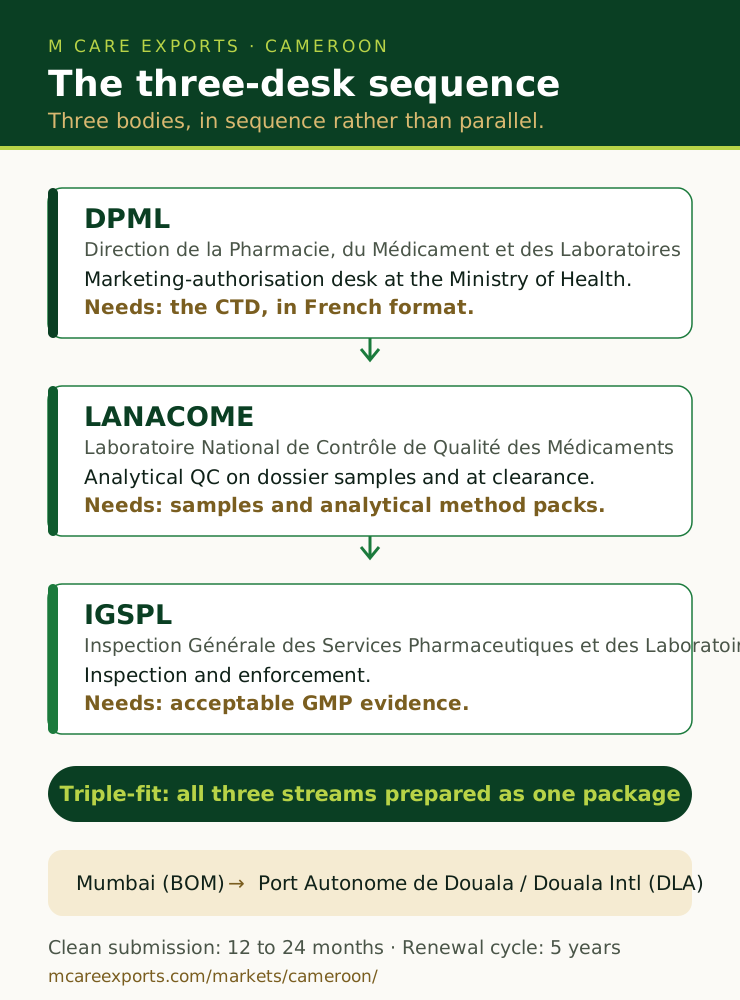
Indian dossiers therefore need a triple-fit: DPML-format CTD in French, LANACOME-ready samples and analytical method packs, and IGSPL-acceptable GMP evidence. M Care Exports prepares all three streams as one package, submitting half-prepared and chasing the rest later is the most common reason Indian dossiers slow in Cameroon. Marketing-authorisation timelines run twelve to twenty-four months on a clean submission and renewals on a five-year cycle.
Cameroon sits inside the Central African Economic and Monetary Community (CEMAC). CEMAC pharmaceutical harmonisation is weak in practice, much weaker than UEMOA in West Africa, so registration is country-by-country across the bloc, and a Cameroonian MA does not transfer to Chad, Gabon, or Congo without separate filings. The currency is XAF (Central African CFA franc, FCFA), pegged to the euro at 655.957, same parity as XOF but a separate currency. Foreign-exchange repatriation can carry friction, which we factor into payment-term recommendations.
On compliance, M Care sources from WHO-GMP certified Indian manufacturing partners, including EU-GMP-inspected sites. We are not US-FDA registered. For Cameroonian buyers procuring against DPML marketing authorisation, CENAME tender qualification, or Global Fund and USAID GHSC-PSM specifications under PEPFAR, our manufacturers' WHO-GMP and EU-GMP credentials map onto what gets accepted in Douala and Yaoundé.
Call & WhatsApp the Mumbai desk: +91 70156 05768 · info@mcareexports.com · Mon–Sat 09:30–18:30 IST
How we serve the Douala and Yaoundé procurement chain
DPML French CTD with LANACOME samples
Module 1 to Module 5 in French alongside LANACOME-ready analytical samples and method-validation packs prepared in one submission rather than across three rounds.
NGO and faith-based supply
Direct supply to CBC Health Services, Cameroon Baptist Convention, Presbyterian Church Cameroon, and Catholic hospital networks whose combined volume often exceeds CENAME public-sector flows.
CENAME tenders with payment-term care
Bid response to CENAME and CAPP regional supply lots with conservative payment-term structuring (LC-at-sight or shorter D/A) given documented public-sector financial stress.
Donor-spec compliant supply
Global Fund HIV/TB/malaria, USAID GHSC-PSM under PEPFAR, UNICEF, Gavi, and ChAI specifications mapped against our manufacturer panel and pre-qualification status.
Anti-counterfeit serialisation
Track-and-trace barcoding, tamper-evident closures, and authenticated French-language patient leaflets in a market where WHO has estimated counterfeit prevalence at significant levels.
Operational geography honesty
We supply Douala, Yaoundé, Bafoussam, and Garoua-route corridors. We do not commit volumes into Northwest and Southwest Anglophone-conflict zones or Far North Boko-Haram-adjacent areas where supply-chain integrity is not predictable.
Routing pharmaceuticals through Port Autonome de Douala and DLA
Sea freight uses Port Autonome de Douala, the gateway not only for Cameroon but for Chad and the Central African Republic. Transit from Nhava Sheva or Mundra runs roughly thirty-five to forty-five days with transshipment generally at Algeciras, Tanger Med, or Las Palmas. Douala port congestion is real and we plan ETAs accordingly rather than quote optimistic booking confirmations. We coordinate with the Cameroonian consignee's transitaire on PAD arrival, with French-language documentation pre-staged.
Air freight runs Mumbai to Douala International (DLA) directly through Addis Ababa, Casablanca, Istanbul, or Dubai, one to two flying days. Yaoundé Nsimalen (NSI) is the secondary air gateway and primarily used for political-capital deliveries. Cold-chain biologicals always go air with active or passive shippers chosen against forecasted ramp dwell at DLA, Douala humidity and ground-handling constraints make passive packaging selection conservative.
Cameroonian customs clearance requires a registered importer with the DPML pharmaceutical-import authorisation, French commercial invoicing, DPML marketing-authorisation reference per SKU, LANACOME quality-control consignment-sample provision where required, and CEMAC tariff documentation. CEMAC FX repatriation friction means payment instruments need to be structured carefully, irrevocable LC-at-sight is the default for first transactions. We pre-package the documentation set in the format Douala transitaires use, which materially reduces dwell at the port.
What Cameroonian buyers procure most often from India
Anti-infectives lead Indian-source procurement into Cameroon. ACT antimalarials, paediatric ARV under Global Fund, anti-TB fixed-dose combinations, ceftriaxone, amoxicillin clavulanate, and metronidazole are the dominant lines. Cameroon's malaria, HIV, and TB burdens are significant and donor-funded volume into the Global Fund principal-recipient channel and PEPFAR-funded GHSC-PSM scopes pulls considerable Indian supply.
Cardiovascular and metabolic categories are the fastest-growing private-channel demand in Douala and Yaoundé. Antihypertensives, statins, oral antidiabetics, basal insulins, and proton-pump inhibitors run through grossistes-répartiteurs and the faith-based hospital networks at meaningful private-pay volumes.
Cold-chain biologicals, insulins, oxytocin, vaccines under Gavi and EPI, flow via DLA with reefer last-mile to CENAME's Douala depot or onward to CAPP regional supply centres. Oncology is a smaller hospital-tender category, mostly through Hôpital Général de Douala, Hôpital Général de Yaoundé, and Centre Pasteur du Cameroun referrals. Surgical consumables are a meaningful Cameroonian Indian-source category as well.
An NGO procurement officer running a faith-based hospital network across the Centre and Littoral regions asked us to take over supply on a basket of antimalarials, paediatric ARV, and basic surgical consumables after their previous Indian supplier had repeatedly missed delivery windows. The hospital network's volume, combined across roughly forty primary-care clinics and three referral hospitals, was greater than what they were lifting from CENAME. We costed the basket in XAF against the EUR-655.957 peg, evidenced WHO-GMP for each manufacturing partner, ran a sample submission through LANACOME for two new SKUs awaiting DPML registration, and structured payment as LC-at-sight for the first two shipments before opening to D/A. The first sea consignment cleared Port Autonome de Douala in thirty-eight days from Nhava Sheva including transshipment at Algeciras, with the documentation pre-accepted by the transitaire. The cold-chain insulin component went air via DLA with reefer last-mile to the Douala distribution depot. Eighteen months in, the network has added a cardiovascular tranche and we have taken on quarterly forecasted shipments rather than ad-hoc orders.
India-led market, French paperwork, honest treatment of CENAME and conflict-region risk
Cameroon is already an India-led pharmaceutical market by source-country volume. Roughly sixty percent of pharma import shipments come from India, and India plus China plus France together account for around eighty-seven percent of imports. What that means in practice is that a Cameroonian importer or NGO procurement officer is not asking whether Indian supply works, they know it does. They are asking which Indian supplier executes documentation, freight, and after-sales discipline at a level that justifies switching from an existing Indian incumbent. That is the comparison M Care welcomes.
We are honest about the country's friction. CENAME has been financially distressed for over a decade, public reporting documents a fall from CFA 15 billion in imports in 2011 to CFA 3 billion by 2020, and we structure payment terms accordingly when bidding into public-sector tenders. The Northwest and Southwest anglophone separatist conflict and Far North insecurity exclude meaningful commerce in those regions; we do not pretend otherwise. Counterfeit prevalence in the Cameroonian market is documented by WHO at significant levels, which is why our anti-counterfeit serialisation and tamper-evident packaging are not optional. Within those realities, the Mumbai-Douala lane delivers, for NGO networks, faith-based hospital systems, private importers, and disciplined CENAME participation.
Procurement, regulatory, and risk questions Cameroonian buyers ask
Who regulates pharmaceutical imports in Cameroon?
Three desks share oversight in sequence. The Direction de la Pharmacie, du Médicament et des Laboratoires (DPML) within the Ministry of Health is the marketing-authorisation regulator and the policy authority. LANACOME, Laboratoire National de Contrôle de Qualité des Médicaments et d'Expertise, performs analytical quality control on dossier samples and on consignment samples at clearance. The Inspection Générale des Services Pharmaceutiques et des Laboratoires (IGSPL) handles inspection and enforcement. M Care Exports prepares dossiers, GMP evidence, and analytical method packs to satisfy all three desks in one submission rather than chasing them sequentially under deficiency pressure, which is the most common reason Indian dossiers slow in Cameroon.
Is India really the largest pharmaceutical source for Cameroon?
Yes. Trade-flow data shows India accounting for roughly sixty percent of pharmaceutical import shipments by volume, with USD 81 million imported from India in 2023 per Trading Economics. India, China, and France together account for around eighty-seven percent of total Cameroonian pharmaceutical imports. That dominance is partly market-driven, Indian generic pricing in XAF works for the Cameroonian buyer profile, and partly regulatory: WHO-GMP credentials and French-translatable CTD packs from Indian manufacturers fit DPML and LANACOME expectations cleanly. The competition for Indian-supplier slots in Cameroon is therefore Indian-versus-Indian, and it is decided on documentation, freight discipline, and after-sales reliability.
How does CENAME procurement work and what is the payment-risk caveat?
CENAME (Centre National d'Approvisionnement en Médicaments Essentiels) is the central public-sector medical store and a member of ACAME. It runs structured tender cycles by lot. The honest caveat: CENAME has been documented as financially distressed, with imports falling from approximately CFA 15 billion in 2011 to CFA 3 billion by 2020, and CAPP regional supply centres operating below it have inherited some of that strain. M Care Exports bids into CENAME tenders selectively, with payment terms structured conservatively, LC-at-sight or shorter D/A windows rather than open-account, and we are transparent with new entrants about the risk of payment delays on public tenders. NGO and faith-based channel volumes often exceed CENAME by total volume and carry more predictable payment profiles.
What about the Anglophone conflict and Far North insecurity?
We do not commit pharmaceutical supply volumes into the Northwest, Southwest, or Far North regions. The Anglophone separatist conflict in the Northwest and Southwest has produced sustained insecurity since 2017, and the Far North faces Boko Haram-adjacent instability. Both environments compromise supply-chain integrity, last-mile reliability, and counterfeit-control. M Care Exports concentrates supply on Douala, Yaoundé, the Centre, Littoral, West, and Garoua corridors where commerce operates normally. Buyers operating across the country sometimes ask us to supply to a central Douala or Yaoundé warehouse and handle their own onward distribution; that is a pattern we support, but we are honest about where our chain-of-custody guarantee actually ends.
What ports and airports do shipments use?
Sea freight routes through Port Autonome de Douala, the gateway for Cameroon, Chad, and the Central African Republic. Transit from Nhava Sheva or Mundra runs thirty-five to forty-five days, with one transshipment at Algeciras, Tanger Med, or Las Palmas. Douala port congestion is real and we plan ETAs against it. Air freight uses Douala International (DLA) primarily and Yaoundé Nsimalen (NSI) secondarily, one to two flying days from Mumbai through Addis Ababa, Casablanca, Istanbul, or Dubai. Cold-chain biologicals always move air via DLA, with active or passive shippers chosen conservatively against forecasted ramp dwell and Douala humidity.
Is the dossier required in French?
Yes. Cameroon is officially bilingual French-English, but pharmaceutical dossier submission to DPML, sample submissions to LANACOME, and import documentation are processed in French. The historical anglophone documentation track that existed in some sectors does not extend to active dossier review in pharmaceutical regulation. M Care Exports manages full French CTD assembly: Module 1 administrative content, Module 2 summaries, Module 3 quality, Module 4 nonclinical, and Module 5 clinical, with certified translation. French patient information leaflets and secondary packaging are also standard. Where customers serve Anglophone-region pharmacies, we can provide bilingual leaflet inserts, but the regulatory submission language remains French.
Does M Care work with Global Fund, GHSC-PSM, and faith-based networks?
Yes. Cameroon is a Global Fund principal-recipient country for HIV, TB, and malaria with significant Indian-source procurement flowing through that channel. USAID GHSC-PSM under PEPFAR funding handles HIV-commodity scopes with established Yaoundé and Douala operations. UNICEF supply division and Gavi vaccines are separate channels controlled by pre-qualification. Faith-based hospital networks, Cameroon Baptist Convention Health Services, Presbyterian Church Cameroon, and Catholic networks, operate procurement at scale that often exceeds CENAME by volume and carry payment profiles that are commercially attractive. We supply across all of these channels within the eligibility rules of each, and we do not over-promise SKUs that fall outside our pre-qualification status.
Mumbai-Douala lane on French paperwork with honest risk handling
Triple-desk dossiers
DPML CTD, LANACOME analytical packs, and IGSPL-ready GMP evidence prepared in one French submission rather than chased sequentially under deficiency-letter pressure.
NGO and faith-based reach
Direct supply to CBC Health Services, Presbyterian and Catholic hospital networks whose combined volumes often exceed CENAME, predictable payment profiles and forecasted cadence.
Honest risk handling
Conservative payment terms on CENAME tenders given documented financial stress, and no commitments into Northwest, Southwest, or Far North regions where supply integrity is not predictable.
Top categories we ship to Cameroon
Anti-infectives
ACT antimalarials, paediatric ARV, anti-TB fixed-dose combinations, and broad-spectrum antibiotics aligned to Global Fund principal-recipient and CENAME procurement.
Oncology
Hospital-tender oncology routed through Hôpital Général de Douala and Hôpital Général de Yaoundé, cytotoxics, hormonal therapy, supportive care.
Cardiovascular
Antihypertensives, statins, antiplatelets, and heart-failure therapy for Douala and Yaoundé private-channel and faith-based hospital demand in XAF pricing.
Diabetes & endocrine
Oral antidiabetics, basal and analogue insulins, thyroid therapy, cold-chain insulin via DLA with reefer last-mile into CENAME or NGO depots.
Respiratory
Inhalers, nebuliser solutions, and paediatric respiratory therapy for Douala, Yaoundé, and West-region hospital networks.
General & OTC
Analgesics, antacids, oral rehydration salts, and family-pharmacy OTC sized for Cameroonian grossiste-répartiteur and pharmacy-chain offtake.
Services Cameroonian buyers commonly bundle
WHO-GMP compliance
GMP evidence packs that DPML, LANACOME, and IGSPL accept on first pass, with audit trails and CoA archives ready for analytical sample testing.
CTD dossier preparation
French CTD assembly for the DPML, Modules 1 to 5 with certified translation, LANACOME analytical methods, and IGSPL-ready GMP evidence.
Cold-chain validated supply
Mumbai to DLA reefer-air with active or passive packaging conservative against Douala humidity, temperature loggers, and reefer last-mile to CENAME or NGO depots.
Bilingual filings, and the Douala lane they travel.
Government tender response
CENAME tenders and CAPP regional supply-centre lots, bid response structured with LC-at-sight or shorter D/A terms given CENAME's documented financial position.
NGO and faith-based procurement
Global Fund, USAID GHSC-PSM under PEPFAR, UNICEF and Gavi specifications, plus direct CBC Health Services, Presbyterian, and Catholic hospital-network baskets.
CTD dossier preparation
Full French CTD assembly for DPML, Modules 1 to 5 with certified translation, plus LANACOME analytical method packs prepared alongside the dossier.
Cold-chain validated supply
Mumbai to Douala International reefer-air, active or passive packaging chosen against Douala humidity and ramp dwell, reefer last-mile into CENAME or NGO depots.
Hospital pharmacy supply
Oncology and formulary lines into Hôpital Général de Douala, Hôpital Général de Yaoundé, and Centre Pasteur du Cameroun referral-hospital pharmacy tenders.
Send the basket and we will return XAF pricing
Share your CENAME lot reference, NGO or faith-based network basket, donor-programme specification, or private-importer shopping list. We will return XAF pricing referenced to the EUR-655.957 peg, DPML marketing-authorisation status against each SKU, Mumbai-to-Douala freight options on sea or air, French commercial invoicing ready for your transitaire, and an honest payment-term recommendation given the buyer profile. First-time engagements typically close their first quotation cycle inside two working weeks.
Start a Cameroon enquiry → Back to all marketsBuying for repeat supply? Open a trade account for a named account manager and priced quotes.