
Cold-chain validation, from the manufacturer's loading bay to your cold room.
2-8C, -20C, -25C and, for dry-ice product, -70C. M Care Exports ships temperature-sensitive pharmaceutical product from Indian WHO-GMP origin into 20 regulated markets with pre-shipment thermal validation, continuous in-transit logging and an on-arrival logger read-out before the carton is opened.
Validated before dispatch. Logged end-to-end. Read out on arrival.
A cold-chain shipment is only as good as the qualification behind the shipper, the logger in the box and the paperwork in the hand of the receiving pharmacist. The standards below are the backbone of every consignment.

The governance standards
WHO TRS 961 Annex 9 on time- and temperature-sensitive pharmaceutical product, supplemented by WHO TRS 1025 Annex 2 and WHO TRS 992 Annex 5. EU GDP 2013/C 343/01 section 9.4 on specified temperature conditions and continuous in-transit monitoring. PIC/S PE 011, the MHRA Orange Guide 2022 and USP General Chapter <1079> underpin shipper qualification and risk-based mitigation.
Where M Care sits
Manufacturer-origin. M Care Exports and its WHO-GMP partner sites own the consignment from the cold room through the Indian airport cold zone to the uplift flight. Your nominated importer, Responsible Person or QP signs off on arrival. The validation work and document pack are prepared at the Indian end, not assembled in flight.
What arrives with the carton
A qualified shipper configuration matched to the lane and season. Continuous logger data from dispatch to delivery. A signed shipper qualification certificate, a thermal-mapping summary for the batch, the in-transit logger read-out and, where needed, a temperature excursion CAPA. The Responsible Person reads the pack before the seal is broken.
Who needs a validated cold chain out of India.
Oncology cytotoxics at 2-8C
Monoclonal antibodies, biosimilars, immunoglobulins and cytotoxics that sit strictly at 2-8C. A summer lane from Mumbai to a Gulf hospital, or a winter lane from Delhi to Frankfurt, behave differently. Lane-season qualification matters more than carton colour.
Vaccine procurement
Ministry of Health tenders, donor-funded paediatric programmes and NGO-led campaigns. Consignment volumes from a few thousand doses to pallet-scale. Temperature-excursion tolerance is near zero. WHO PQS pre-qualified shipper profiles used where the donor specifies.
Biologicals, insulins, haemophilia factor
Insulin analogues, recombinant factor VIII and IX, growth hormones, GLP-1 agonists. Strict 2-8C, with defined cumulative time-out-of-storage budgets that the stability data and the QA dossier both sign off. Homecare delivery windows negotiated in advance.
Deep-freeze and dry-ice product
mRNA and select biological products that require -20C, -25C, or, for specific consignments, dry-ice -70C. Reserved for qualified lanes only. Dry-ice dangerous-goods paperwork, airline acceptance and carrier SLA confirmed before the batch leaves the manufacturer's warehouse.
The paperwork the Responsible Person reads before the carton is opened.
Six documents travel with every cold-chain consignment. Electronic copies go ahead of uplift; physical copies live in the outer carton sleeve.
Shipper qualification certificate
Operational qualification of the shipper configuration in a climate chamber across summer, winter and intermediate profiles. Performance qualification on a live lane. Certificate lists shipper model, payload, pre-conditioning, ambient challenge and hold time.
Thermal-mapping report
Cold-room and shipper mapping studies against ISTA 7D and the USP <1079> risk framework. Mapping sensors placed at worst-case positions. Report summarises hot-spot and cold-spot data and the mitigation applied for the batch.
Pre-shipment thermal challenge
Each batch is thermally challenged before dispatch. Pre-conditioned phase-change material weighed and verified. Payload loaded to qualified fill ratio. Closure sequence and logger start-time documented. Sign-off by the QA officer on duty.
In-transit logger
Continuous temperature logger inside the payload. Single-use USB PDF logger on small consignments; connected IoT logger on pallet-scale or high-value batches (Sensitech TempTale, Elpro Libero CX or equivalent). NABL-accredited calibration in India, NIST-traceable where the importer specifies.
On-arrival logger read-out
Logger downloaded before the carton is broken. PDF read-out, min and max, mean kinetic temperature and cumulative time-out-of-storage issued to the Responsible Person. Hold-or-release recommendation attached. No assumption that a carton is good because it looks cold.
Excursion protocol and CAPA
A written excursion protocol defines the time-out-of-storage budget per product and the escalation path. Where an excursion is logged, a CAPA is issued: root-cause analysis, impact assessment against the product stability file, corrective action on the lane, and a hold-or-release decision signed by manufacturer QA.
Enquiry to on-arrival read-out. Five steps. One document pack.
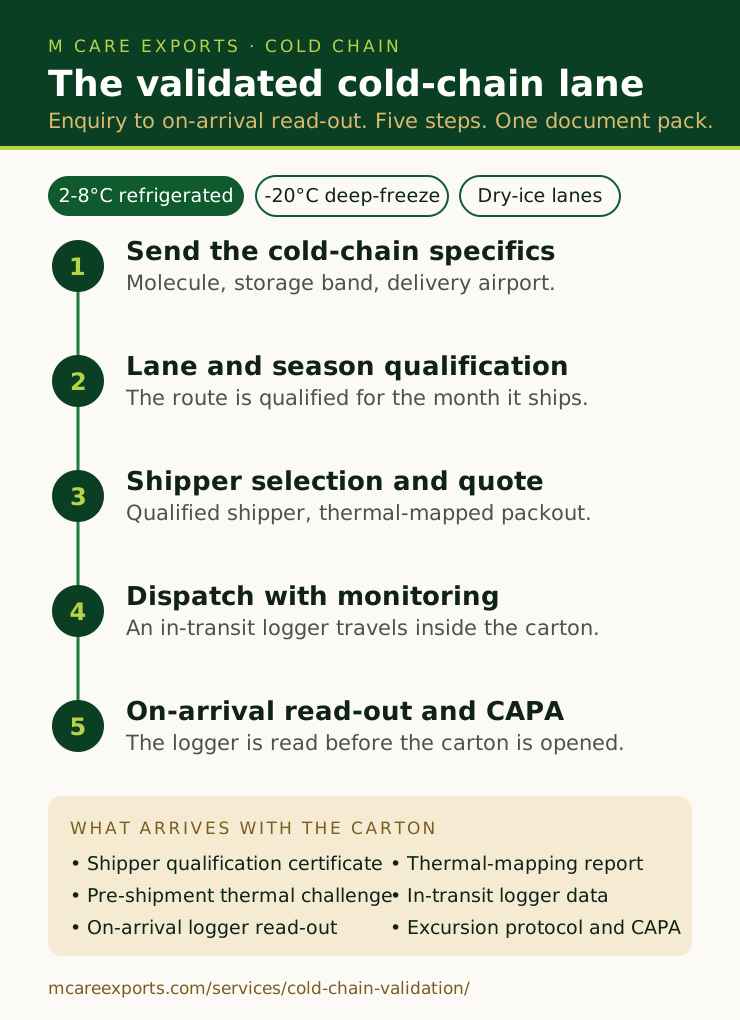
- Send the cold-chain specifics. Molecule, strength, dosage form, quantity, the required storage band (2-8C, -20C, -25C, -70C) and the delivery airport. Name the importer, the target arrival window and any donor or tender shipper requirement.
- Lane and season qualification. We map the lane, for example BOM-LHR, DEL-FRA, HYD-DXB, BLR-NBO, against the season and ambient risk. Existing qualified lanes go straight to shipper selection; a new lane triggers a route risk assessment before quotation.
- Shipper selection and quote. Polystyrene 24h passive, vacuum-insulated panel 72h, or active pallet containers (Envirotainer RKN e1, CSafe RAP, DoKaSch-class) for 120h-plus lanes. Shipper model, payload, logger spec, dangerous-goods handling and landed price confirmed in writing.
- Dispatch with monitoring. Pre-conditioned shipper, qualified fill, logger start, dispatch to the cold-chain airfreight consolidator. Live tracking on IoT lanes; scheduled milestone check-ins on passive lanes. Dangerous-goods paperwork cleared for dry-ice consignments.
- On-arrival read-out and CAPA. Logger downloaded before the carton is opened. Read-out and hold-or-release recommendation issued to the Responsible Person. Excursion CAPA opened where required and closed with the importer's QA before the batch moves to dispensing.
Cold-chain validation, the specifics.
Which temperature bands do you ship?
2-8C is the workhorse band, biologicals, monoclonal antibodies, insulins, vaccines, many oncology cytotoxics. We also run -20C and -25C deep-freeze lanes for specific products, and occasional dry-ice -70C consignments where the stability data and the carrier accept it. Controlled room temperature 15-25C lanes are qualified separately for heat-sensitive but non-cold product. Every band has its own qualified shipper and lane record; we do not interchange them.
Is the shipper validation yours or the manufacturer's?
Both, depending on the lane. The WHO-GMP manufacturer holds operational qualification data for the shipper at batch release. M Care holds performance qualification data for the lane itself, the BOM-LHR or DEL-DXB leg in summer or winter. Where a consignment uses a shipper configuration that is new to the lane, we run a lane-qualification study against the shipper's OQ profile and issue a combined qualification certificate with the consignment.
What governance standards do you follow?
WHO TRS 961 Annex 9 on time- and temperature-sensitive pharmaceutical product is the primary reference. We cross-map to WHO TRS 1025 Annex 2, WHO TRS 992 Annex 5, EU GDP 2013/C 343/01 section 9.4, PIC/S PE 011, the MHRA Orange Guide and USP General Chapter <1079>. Shipper testing references ISTA 7D. The importer's local GDP inspectorate is the ultimate audience for the document pack, so the pack is written to the stricter of the applicable guidelines.
What happens if there is a temperature excursion?
The logger flags the excursion on read-out; it does not depend on a visual check. A written excursion protocol defines the time-out-of-storage budget against the batch stability data. A CAPA is opened the same day: root cause (lane, shipper, carrier, human), impact assessment, corrective action, and a hold-or-release recommendation. The importer's Responsible Person holds the final call on release. We have never asked an importer to release a batch over their QA's objection and never will.
Which loggers do you use?
Single-use USB PDF loggers on small consignments, where the importer reads out the PDF on arrival. Connected IoT loggers on pallet-scale and high-value consignments, typically Sensitech TempTale or Elpro Libero CX class, giving live milestone alerts during transit. All loggers are calibrated to NABL-accredited standards in India, with NIST-traceable certificates available where the EU, UK or US importer requests it. Logger serials are tied to the consignment's paperwork, not supplied separately.
Can you ship into NGO or donor procurement programmes?
Yes. Donor-funded programmes (Global Fund, Gavi pipeline, UNICEF, MSF) and WHO-PQ aligned tenders are a regular lane. The donor's shipper and logger specification, cold-chain audit trail and excursion reporting format are accommodated ahead of dispatch, not negotiated after the carton lands. See NGO and donor procurement for the full scope.
How many hours of hold time do the shippers give?
Polystyrene passive shippers with conditioned gel-pack qualify typically to 24 hours at 2-8C against the summer ambient profile. Vacuum-insulated panel (VIP) shippers qualify to 72 hours, sometimes 96. Active containers, Envirotainer RKN e1, CSafe RAP and DoKaSch class, run pallet-scale consignments to 120 hours and beyond on a single charge. We never run a lane whose door-to-door time exceeds 70 percent of the shipper's qualified hold, there has to be margin for a missed flight.
Do you handle the dangerous-goods side for dry ice?
Yes. Dry ice is a regulated dangerous good under IATA for air carriage. Net weight calculated and declared, shipper's declaration issued, airline acceptance confirmed before the batch leaves the cold room. We only run dry-ice consignments on airline and consolidator pairs we have already qualified; we do not dry-ice through a new carrier without a dry run. See also our named-patient UK import route for urgent single-patient cold-chain cases.
Molecule, storage band, delivery airport. That's the start of the conversation.
The Mumbai desk will come back inside one working day with lane qualification, shipper options and a landed cold-chain quote. No carton leaves without a qualification certificate and a live logger.
Buying for repeat supply? Open a trade account for a named account manager and priced quotes.